Leaning into LLM’s translations of my prompts
I’m not alone taking a prompt and using it across AIs. My rational mind understands how the models are different. But my emotional mind worries about who owns the plot in the stories I’m telling.
I’m thinking about it as, the baseline story is my prompts and the AI model is the reader.
Scott McCloud and his book, “Understanding Comics” illustrates the idea as what happens between the panels of comics.
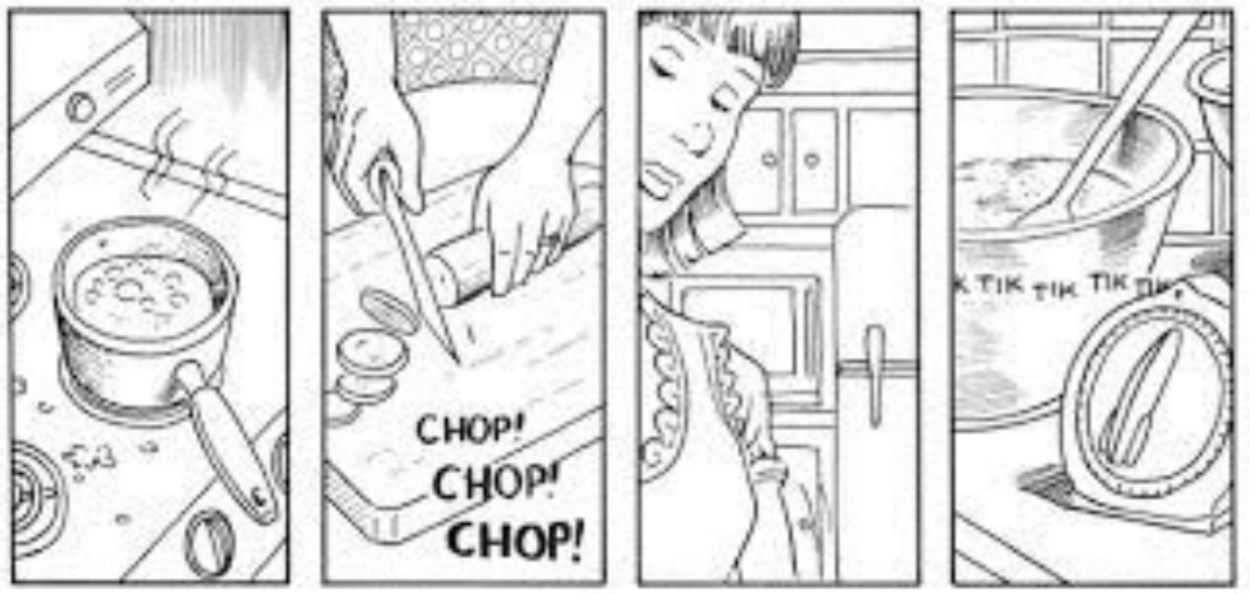
His diagram illustrates the different roles of the author and the readers. He talks about the narrative that happens between the two.
In McCloud’s diagram, the reader brings life experience to the story. We don’t need to see people eating to know food is being prepared. He warns that not everyone brings the same story to the panels. Is it a vegetable being chopped or a sausage?
Interpretation depends on age, culture, etc. A lot like the LLMs from different AI. This model helps me think about what gets included in my prompts - how much of the story am I driving and how much do I want the AI to drive.
In the first model, I own the story. It is based on my experience. I can control if the panel is about chopping sausage or cutting a log of cookie dough.
Jody’s prompt
AI adds to the story
Jody’s prompt
AI adds to the story
Jody’s prompt
AI builds the story
Jody’s prompt
AI adds to the story
My approach makes each designer a creator with unique approaches to stories. And I need to focus on teams approach work that needs to hold together into one product.
Because how I tell my stories will be very different from my collaborators and partners. Now Ai adds a new variable.
Continuity can become a challenge as teams accelerate the work. Because now we have a new level:
Know our audience and the story they need
Define the story that meshes user and business goals
The stories we use with AI to create prototypes <-NEW!
And then we need the time to learn, experiment, and apply.
What I’ve described is counter to the propaganda: AI saves time. Like so many things in product design, the answer is sometimes for some things.
Thanks to Steven Johnson, who introduced me to both Jane Jacobs and Scott McCloud during his time as adjunct professor at NYU’s ITP,